Qualification summary
Hot-rolled product forms and the minimum specification
Hot-rolled steel cannot be selected from thickness alone. The purchasing decision begins with product form, then standard, grade, delivery condition, dimensions, tolerance, surface, edge, testing and documentation.
| Product form | Buyer meaning | Main specification fields |
|---|---|---|
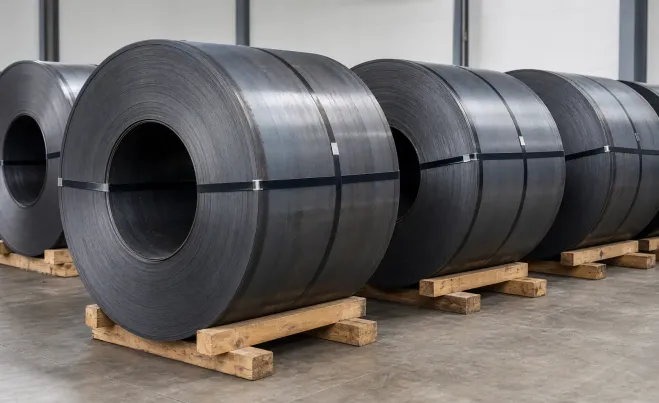
| Hot-rolled coil (HRC) | Continuously rolled flat steel supplied in coil form | Grade, thickness, width, coil ID/OD, coil mass, edge, surface and tolerance |
| Hot-rolled sheet | Cut-to-length sheet, commonly processed from coil | Grade, thickness, width, length, flatness, edge and surface |
| Heavy plate | Individually rolled or cut plate for structural and project use | Grade, dimensions, delivery condition, UT or through-thickness requirements and marking |
| Pickled and oiled (HRPO) | Hot-rolled material with scale removed and temporary oil protection | Pickling, oil, surface expectation, downstream process and packing |
| Skin-passed hot-rolled steel | Light temper rolling used to improve shape and reduce coil-break sensitivity | Elongation target, flatness, surface and forming route |
There is no safe universal sheet/plate thickness cut-off. State the required form and dimensions explicitly because terminology varies by standard, market and supply route.
Standards
Standards map for hot-rolled coil, sheet and plate
State the required standard edition in the RFQ or contract. A grade name without its standard, delivery condition and applicable thickness range is incomplete.
| Standard | Technical scope | Common grades or topics |
|---|---|---|
| EN 10149-2 | Thermomechanically rolled high-yield-strength steels for cold forming | S315MC-S700MC |
| EN 10111 | Continuously hot-rolled low-carbon sheet and strip for cold forming | DD11-DD14 |
| EN 10025-2 | Non-alloy structural steels | S235JR, S275JR, S355JR/J0/J2/K2 |
| EN 10025-3 | Normalized or normalized-rolled weldable fine-grain steels | S355N, S355NL |
| ASTM A572/A572M | High-strength low-alloy structural steel | Grades 42, 50, 55 and 60 |
| ASTM A131/A131M | Structural steel for ships | A, B, D, E and AH/DH/EH/FH 32/36 |
| EN 10028-2/-3 | Flat products for pressure purposes | P235GH, P265GH, 16Mo3, P295GH, P355GH/NH/NL1 |
| ASTM A516/A516M | Carbon steel plate for pressure vessels | Grades 55, 60, 65 and 70 |
| EN 10051 | Tolerances for continuously hot-rolled strip, sheet and plate cut from wide strip | Thickness, width, length, flatness and shape |
| EN 10029 | Tolerances for hot-rolled plate 3 mm thick or above | Plate thickness, flatness, width and length |
| EN 10160 | Ultrasonic testing of flat products 6 mm thick or above | Body and edge acceptance classes |
| ASTM A435/A435M and A578/A578M | Straight-beam ultrasonic examination of plate | General and special-application acceptance |
| EN 10204 | Inspection documents for metallic products | Types 2.2, 3.1 and 3.2 |
Grade guide
EN 10149-2 hot-rolled HSLA grades
The S-MC family combines low carbon content with microalloying additions such as niobium, titanium and vanadium. Strength is developed mainly through grain refinement and precipitation hardening.
The designation identifies structural steel (`S`), minimum yield strength for the applicable thickness, thermomechanical rolling (`M`) and suitability for cold forming (`C`).
| Grade | Re min. (MPa) | Rm (MPa) | A80 min., d < 3 mm | A5 min., d ≥ 3 mm | Impact at −20 °C | 180° transverse bend |
|---|---|---|---|---|---|---|
| S315MC | 315 | 390-510 | 20% | 24% | 40 J | 0d |
| S355MC | 355 | 430-550 | 19% | 23% | 40 J | 0.5d |
| S420MC | 420 | 480-620 | 16% | 19% | 40 J | 0.5d |
| S460MC | 460 | 520-670 | 14% | 17% | 40 J | 1d |
| S500MC | 500 | 550-700 | 12% | 14% | 40 J | 1d |
| S550MC | 550 | 600-760 | 12% | 14% | 40 J | 1.5d |
| S600MC | 600 | 650-820 | 11% | 13% | 40 J | 1.5d |
| S650MC | 650 | 700-820 | 10% | 12% | 40 J | 2d |
| S700MC | 700 | 750-950 | 10% | 12% | 40 J | 2d |
`d` is product thickness. The source applies tensile values to longitudinal specimens and notes thickness-dependent qualifications. Confirm the applicable current standard table and ordered thickness.
| Buyer requirement | Technical implication |
|---|---|
| Higher strength and lower component mass | Move upward within the S-MC series, then re-check bend radius, elongation, fatigue and welding heat input |
| Severe forming | A lower-strength grade generally provides a wider forming window |
| Fatigue-loaded component | Evaluate surface, edge, weld detail, thickness and target cycle life; static yield strength is not enough |
| Pickled surface | Improves cleanliness but does not increase the base material’s mechanical properties |
| Skin pass | Can improve shape and reduce discontinuous yielding or coil-break sensitivity |
These are selection prompts, not automatic grade approvals.
Forming
EN 10111 drawing grades: DD11 to DD14
DD grades are low-carbon hot-rolled steels intended for cold forming, from general bending to more demanding drawn parts.
| Grade | C max. | Mn max. | Re, 1.5 ≤ d < 2 mm (MPa) | Re, 2 ≤ d ≤ 11 mm (MPa) | Rm max. (MPa) | A5 min., 3 ≤ d ≤ 11 mm |
|---|---|---|---|---|---|---|
| DD11 | 0.11 | 0.50 | 170-360 | 170-340 | 440 | 28% |
| DD12 | 0.09 | 0.40 | 170-340 | 170-320 | 420 | 30% |
| DD13 | 0.07 | 0.35 | 170-330 | 170-310 | 400 | 33% |
| DD14 | 0.08 | 0.35 | 170-310 | 170-290 | 380 | 36% |
The source applies these tensile values to transverse specimens. Confirm ageing guarantees, delivery date, storage and contractual validity because forming behaviour can be time-sensitive.
Plate selection
Structural, shipbuilding and pressure-vessel plate
Structural suffixes carry delivery-condition and toughness meaning. Yield strength also decreases as thickness increases, so the thinnest-product value must not be applied to a thicker plate.
| Suffix | Procurement meaning |
|---|---|
| +AR | As rolled |
| +N | Normalized or normalized rolled |
| JR | 27 J impact energy at +20 °C |
| J0 | 27 J impact energy at 0 °C |
| J2 | 27 J impact energy at −20 °C |
| K2 | Higher specified impact energy; confirm the ordered grade table |
| N / NL | Fine-grain normalized condition, with NL carrying lower-temperature toughness requirements |
For shipbuilding plate, specify classification-society requirements, thickness, impact temperature, inspection scope and whether EN 10204 type 3.2 validation or witnessing is required.
| Grade | Re min. at d ≤ 16 mm (MPa) | Rm, 3 ≤ d ≤ 100 mm (MPa) | A min. | Impact requirement |
|---|---|---|---|---|
| S235JR | 235 | 360-510 | 24% | 27 J at +20 °C |
| S275JR | 275 | 410-560 | 21% | 27 J at +20 °C |
| S355JR | 355 | 470-630 | 20% | 27 J at +20 °C |
| S355J0 | 355 | 470-630 | 20% | 27 J at 0 °C |
| S355J2 | 355 | 470-630 | 20% | 27 J at −20 °C |
| S355K2+N | 355 | 470-630 | 20% | 40 J at −20 °C in the source table |
Never use the d ≤ 16 mm yield value for a thicker plate without checking the applicable standard table.
| Pressure grade | Re min. (MPa), d ≤ 16 / 16-40 / 40-60 mm | Rm (MPa) | A5 min. | Catalogue-stated impact |
|---|---|---|---|---|
| P235GH | 235 / 225 / 215 | 360-480 | 24% | 27 J at −20 °C |
| P265GH | 265 / 255 / 245 | 410-530 | 22% | 27 J at −20 °C |
| 16Mo3 | 275 / 270 / 260 | 440-590 | 22% | 31 J at +20 °C |
| P295GH | 295 / 290 / 285 | 460-580 | 21% | 27 J at −20 °C |
| P355GH | 355 / 345 / 335 | 510-650 | 20% | 27 J at −20 °C |
| P355NL1 | 355 / 345 / 335 | 490-630 | 22% | 27 J at −40 °C |
Pressure-equipment requirements may add design temperature, PED conformity, NDT, heat treatment and supplementary testing.
Engineering behaviour
Weldability, forming, fatigue and heat treatment
The source uses the IIW carbon-equivalent formula: CEV = C + Mn/6 + (Cr + Mo + V)/5 + (Ni + Cu)/15.
CEV is only a first-pass screen. Welding decisions also depend on actual chemistry, product thickness, restraint, hydrogen level, heat input, joint geometry, preheat/interpass temperature and required toughness.
Forming Limit Curves are grade-, thickness-, surface- and condition-specific. Increasing strength generally narrows the forming window. Fatigue assessment must include load ratio, surface and edge quality, mean stress, weld detail and target cycle life.
Grades intended for quenching and tempering obtain final properties from the heat-treatment cycle. Specify delivery condition, hardenability evidence, section thickness, target hardness and final-property verification.
| CEV | Catalogue screening interpretation |
|---|---|
| ≤ 0.30 | Excellent weldability; often weldable without special treatment |
| > 0.30 and < 0.55 | Weldable with suitable consumables and temperature control |
| ≥ 0.55 | Special welding practices required |
Order controls
Surface, tolerances, inspection and traceability
| Requirement | What to state in the RFQ |
|---|---|
| Pickled and oiled | Surface cleanliness, oil type or amount, downstream painting/forming and packing |
| Skin passed | Coil-break sensitivity, flatness, surface texture and elongation target |
| Hot-dip galvanizing suitability | Required chemistry window and galvanizing category; do not infer suitability from grade name |
| Thickness tolerance | EN 10051 class or exact agreed narrowed tolerance |
| Plate flatness | EN 10029 class and project-specific flatness requirement |
| Edge | Mill edge, trimmed edge or slit edge |
| Tensile test | Standard, specimen orientation, thickness location and acceptance values |
| Charpy impact | Temperature, energy, orientation, specimen size and frequency |
| Ultrasonic testing | EN 10160 class or ASTM A435/A578 level, body/edge scope and reporting |
| Inspection document | EN 10204 3.1 or 3.2 and any third-party witnessing |
| Traceability | Heat number, coil or plate number, grade, dimensions and individual marking requirement |
Buyer checklist
Hot-rolled steel RFQ checklist
Send the product form; governing standard, grade and edition; delivery condition; thickness, width and length; coil ID/OD and maximum mass; required properties at the ordered thickness; forming and welding details; service temperature and Charpy requirements; surface, flatness, tolerance and edge; special tests; EN 10204 document type; marking, traceability, packing, quantity, destination and Incoterm.
SteelFromTurkey supplies hot-rolled flat steel against order-defined grade, dimensions, processing, documentation and inspection requirements.
FAQ
Hot-rolled steel technical questions
Is S355 always 355 MPa yield strength?
No. Minimum yield strength depends on the exact grade, delivery condition, product form and thickness range. Check the current standard table and the MTC.
Does pickling and oiling improve mechanical strength?
No. Pickling removes scale and oil provides temporary corrosion protection. These processes affect surface condition, not the base grade’s specified strength.
Can S700MC be selected only because it has the highest yield strength?
No. Higher strength can reduce elongation and forming margin. Bend radius, edge quality, fatigue, welding and the actual component process must be reviewed.
When should plate ultrasonic testing be specified?
Specify UT when the governing standard, project risk or design requirement calls for internal-quality examination. State the method, class or acceptance level, body/edge scope and reporting.
Which inspection document should be requested for hot-rolled steel?
The order must state the required document type. EN 10204 type 3.1 is common for specific inspection results; type 3.2 is used when the required independent validation route is written into the order.