Supply overview
Aluminium Sheet and Plate Supply From Turkey
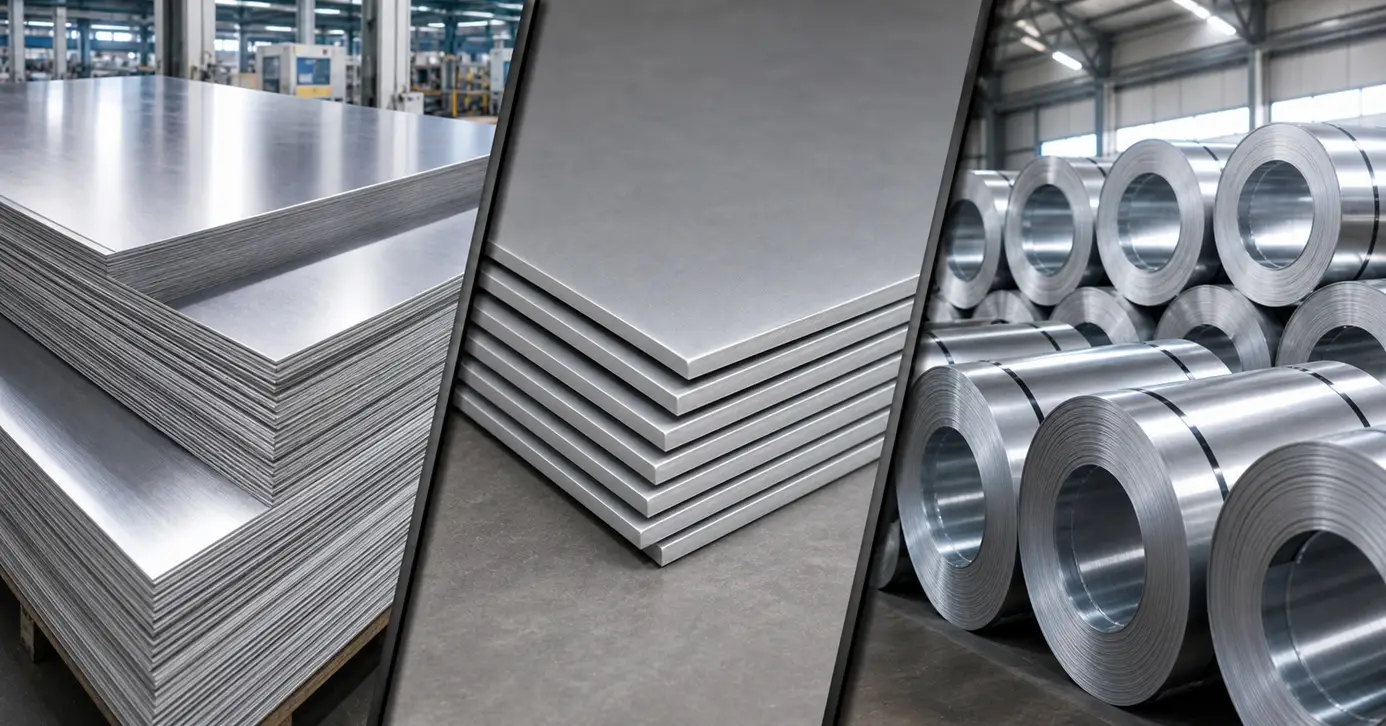
Aluminium sheet and plate are used across fabrication, marine, transport, machinery, architecture, enclosure, panel and equipment applications. Buyers may search for sheet aluminium, metal sheet aluminium, aluminium plate, aluminium metal plate or aluminium sheet plate when they are still deciding the right flat product form.
For quotation accuracy, the product name alone is not enough. Alloy, temper, thickness, width, length, tolerance, surface condition, protective film, packing and delivery term affect availability and price. A thin forming sheet is not the same requirement as a 5083 marine plate or a 6082 plate for machined structural parts.
SteelFromTurkey reviews aluminium flat product RFQs against the requested standard and application. ASTM B209/B209M is commonly used for aluminium sheet and plate in ASTM markets, while EN and Aluminium Association alloy designations are often used for European and international supply. Exact certificate scope, mechanical properties and dimensional tolerance should be confirmed at order stage.
What changes the quote
Alloy, temper, thickness, dimensions, tolerance, surface, packing and delivery term all change availability and price.
Why review matters
A thin forming sheet is not the same requirement as a 5083 marine plate or a 6082 plate for machined parts.
Selection guide
Choose Between Aluminium Sheet and Aluminium Plate
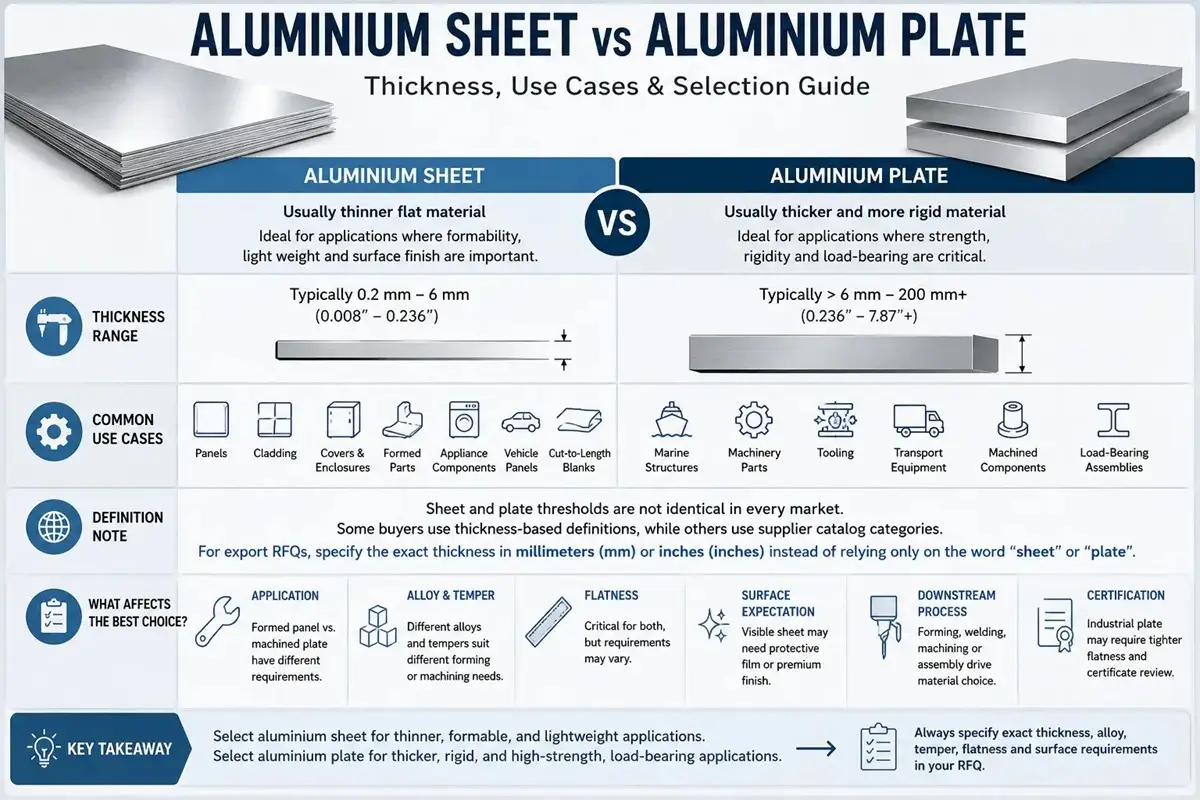
Aluminium sheet is usually selected when the buyer needs thinner flat material for panels, cladding, covers, enclosures, formed parts, appliance components, vehicle panels or cut-to-length blanks. Aluminium plate is usually selected when the buyer needs thicker and more rigid material for marine structures, machinery parts, tooling, transport equipment, machined components or load-bearing assemblies.
Sheet and plate thresholds are not identical in every market. Some buyers use thickness-based definitions, while others use supplier catalog categories. For export RFQs, specify the exact aluminium sheet metal thickness or aluminium plate thickness in millimeters or inches instead of relying only on the word sheet or plate.
The best route depends on application, alloy, temper, flatness, surface expectation and downstream process. A formed panel may need a different alloy and temper than a machined plate. A visible sheet may need protective film, while an industrial plate may need tighter flatness or certificate review.
Aluminium Sheet Product Card
| Best Fit | Typical Specification Inputs | Next Step |
|---|---|---|
| Aluminium sheet metal, coil-derived sheet, cut-to-length sheet, panels, covers, enclosures, formed parts and repeat fabrication blanks | Alloy, temper, thickness, width, length, surface finish, protective film, sheet or coil form, bundle weight, MTC requirement and destination | Request a quote |
Aluminium sheet is the better starting point when the buyer needs sheet aluminium for forming, cladding, panel work, lightweight covers or coil-based processing. If the requirement is already sheet-specific, send an RFQ to prepare a product-specific quote.
Aluminium Plate Product Card
| Best Fit | Typical Specification Inputs | Next Step |
|---|---|---|
| Aluminium metal plate, marine plate, machinery plate, tooling plate, transport equipment, machined parts and thicker flat aluminium | Alloy, temper, thickness, width, length, flatness, surface, testing or certificate need, packing, quantity and destination | Request a quote |
Aluminium plate is the better route when rigidity, thickness, machining behavior, marine corrosion resistance or structural performance matters more than forming. If the inquiry is plate-specific, send an RFQ to request a quote.
Terminology Note: Aluminium Is Not Steel
Aluminium and steel are separate material families. Searches such as aluminium steel sheet or aluminium steel plate usually mean the buyer is comparing material options, not asking for a single combined product. If weight, corrosion behavior, strength, joining method or cost is still undecided, compare aluminium options with steel sheet and plate before finalizing the RFQ.
Sheet route
Use when formability, visible surface quality, lighter gauge and coil-based processing matter most.
Plate route
Use when thickness, rigidity, machining allowance, flatness and structural performance matter most.
Product routes
Move Into The Right Product Route
If the requirement is already clear, use the product cards below to continue with the right sub-product page before the final RFQ.
 Sheet
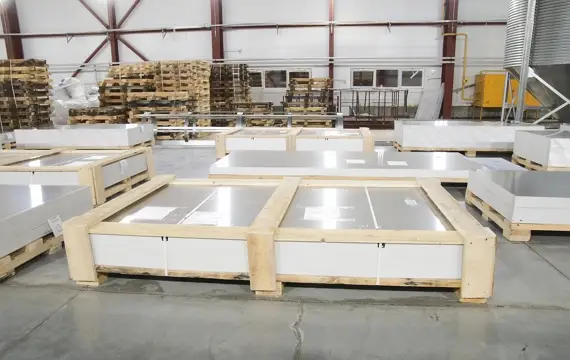
SheetBest when the requirement is thinner flat material for forming, cladding, panel work and repeat fabrication blanks.
View Sheet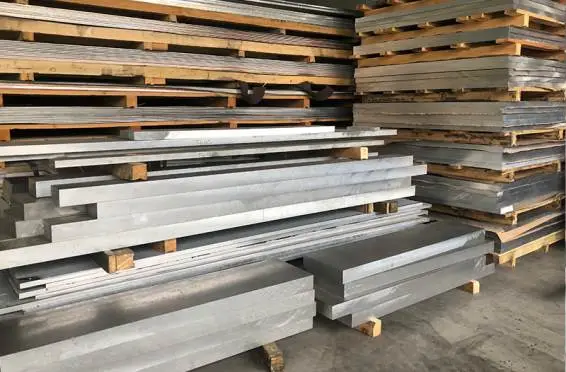 Plate
PlateBest when rigidity, machining behavior, marine corrosion resistance or structural performance matters more than forming.
Request QuoteForms and supply
Sheet, Coil, Roll and Cut-to-Length Forms
Flat aluminium can be supplied as coil, roll, standard sheet packs, cut-to-length sheets or plate. Aluminium roll and aluminium roll sheet language often points to thin-gauge sheet supplied from coil. Aluminium coil sheet requirements should define coil ID, coil weight, width, thickness, surface, edge and whether the buyer needs slitting or cut-to-length processing.
Sheet packs are useful when buyers need ready-to-fabricate blanks or fixed dimensions. Coil can be more efficient for high-volume processing, continuous lines, local service centers or repeat fabrication. Plate is usually supplied in fixed lengths and widths rather than roll form.
MOQ, lead time and packing can change by form. A stocked sheet size, a non-standard cut-to-length order and a specific alloy/temper plate may require different supply routes. Buyers should state unloading limits, bundle or coil weight limits and preferred packing method when the material will be shipped internationally.
Coil route
Define coil ID, coil weight, width, thickness, edge, surface and whether slit or cut-to-length processing is needed.
Sheet pack route
Use fixed dimensions, bundle or pallet limits, and destination handling details for ready-to-fabricate material.
Material selection
Alloy and Temper Selection
Alloy and temper selection should be based on application, forming, welding, corrosion exposure, machining, strength requirement and surface expectation. The table below is selection guidance only. Final availability, mechanical properties and certificate values should be confirmed through the applicable standard and mill test certificate.
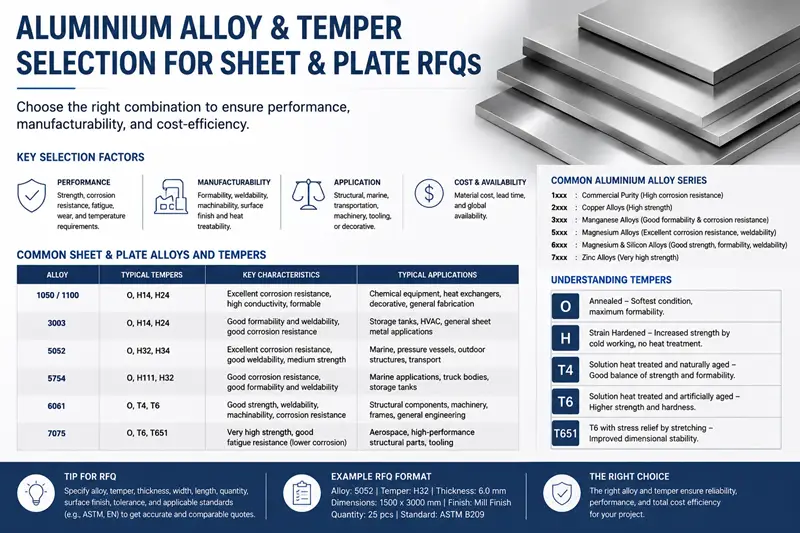
Common Sheet Alloys
| Alloy / Series | Typical Use | Buyer Note |
|---|---|---|
| 1050 / 1100 | General sheet work, conductivity, simple formed parts and corrosion-resistant light-duty uses | Low strength, high workability and corrosion resistance |
| 3003 | General sheet fabrication, panels, tanks, covers and light formed parts | Good general-purpose sheet option where high strength is not the main driver |
| 5052 | Formed sheet, marine-adjacent parts, transport panels and corrosion-resistant fabrication | Stronger than 3003 with good corrosion resistance and formability |
| 5754 | Automotive, transport, tread/checker plate routes where available and marine-adjacent applications | Common European 5xxx option for forming and corrosion resistance |
Common Plate Alloys
| Alloy / Series | Typical Use | Buyer Note |
|---|---|---|
| 5083 | Marine plate, shipbuilding-related parts, tanks and welded structures | H116 or H321 may be relevant for marine exposure depending on standard and class requirement |
| 6061 | General mechanical plate, machined parts and structural components | T6 or T651 is common where strength and machining are important |
| 6082 | Structural and mechanical plate, transport equipment and machined components | Popular European 6xxx structural alloy |
| 7075 | High-strength components where supply and certification are confirmed | High strength, but welding and corrosion behavior require careful review |
Temper matters. O temper supports forming, H tempers are used for strain-hardened non-heat-treatable alloys, and T6/T651 tempers are common for heat-treated 6xxx and 7xxx plate. For 5xxx marine plate, H116 or H321 may be requested when corrosion resistance in seawater exposure is critical.
Common sheet alloys
1050, 1100, 3003, 5052 and 5754 cover general sheet work, conductivity, forming and corrosion resistance.
Common plate alloys
5083, 6061, 6082 and 7075 cover marine, structural, mechanical and high-strength plate routes.
Dimensions
Thickness, Width, Length and Tolerance Requirements
Aluminium sheet metal thickness and aluminium plate thickness are central to both technical fit and pricing. Thickness affects weight, strength, forming behavior, available alloy/temper combinations, cutting method, packing and freight.
For sheet RFQs, send thickness, width, length, alloy, temper, surface, protective film requirement, edge condition and quantity. For plate RFQs, also state flatness, tolerance class, machining requirement, testing, certificate type and whether the plate will be welded, machined or used in marine service.
When the tolerance is not known, share the downstream process. A cosmetic panel, a laser-cut blank, a bent cover, a marine component and a machined base plate do not need the same tolerance package. Clear application context helps SteelFromTurkey review the RFQ against a suitable Turkish supply option.
Sheet RFQ
Send thickness, width, length, alloy, temper, surface, film, edge condition and quantity.
Plate RFQ
Also send flatness, tolerance class, machining requirement, testing and certificate type.
Surface and logistics
Surface Finish, Protective Film and Packing
Surface expectations should be stated before comparing offers. Mill finish may be suitable for many industrial applications. Brushed, polished, tread/checker or coated surface requirements should be confirmed by RFQ because availability depends on alloy, thickness, quantity and supplier capability.
Protective film can help reduce handling marks on visible sheets or formed panels. Interleaving, moisture protection, edge protection, bundle marking, palletizing and crate design may be needed for export shipments. Plate shipments may require heavier supports and lifting access, while thin sheet packs may need stronger corner and surface protection.
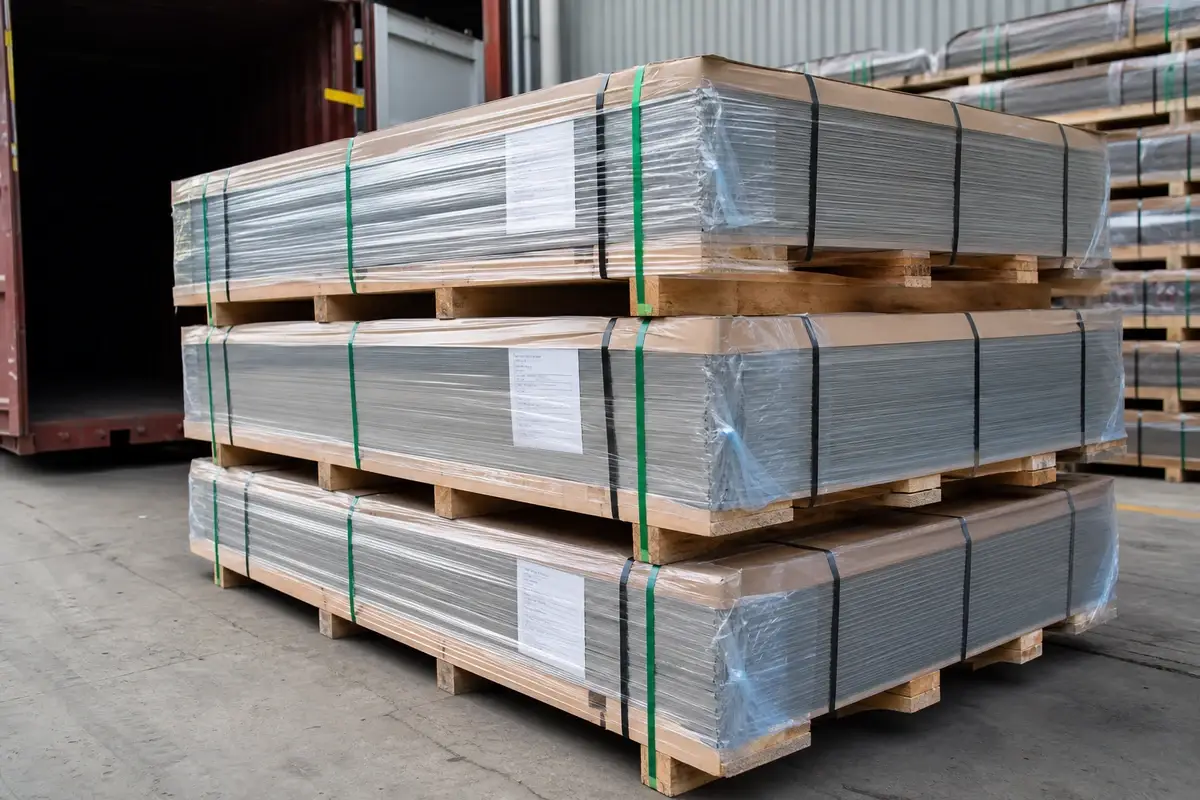
Packing should match the destination, handling method and shipping route. For sea freight, specify whether seaworthy packing, container loading support, bundle labels or special moisture protection is required.
Visible sheet
Confirm film, interleaving, handling-mark sensitivity and surface expectation before offer comparison.
Export packing
State seaworthy packing, moisture protection, bundle marking and lifting constraints early.
Processing
Cutting, Forming and Processing Options
Cutting sheet aluminium, slitting, cut-to-length supply, simple forming and machining-related preparation can be reviewed at RFQ stage. Processing availability depends on alloy, temper, thickness, tolerance, quantity, surface expectations and the verified supply partner selected for the order.
Aluminium sheet forming requirements should include bend radius, bend direction if relevant, surface visibility and whether cracking or marking is a concern. Plate machining requirements should include final part use, flatness expectation, machining allowance and whether stress-relieved temper is needed.
For repeat parts, drawings are useful. For service-center style requirements, send slit width, cut length, coil or sheet form, packing and delivery schedule. SteelFromTurkey can review the specification and route the RFQ to the most relevant Turkish supply option instead of treating all flat aluminium as interchangeable.
Forming note
Send bend radius, bend direction, visible-surface expectation and cracking or marking concerns.
Machining note
Send final part use, flatness expectation, machining allowance and stress-relieved temper needs.
Why Turkey
Why Source Aluminium Flat Products From Turkey?
Turkey has an established aluminium processing and export base serving Europe, the Middle East and North Africa. For buyers comparing supply origins, Turkey offers industrial capability, logistics access, export documentation and proximity to major ports.
SteelFromTurkey supports aluminium sheet and plate buyers as a Turkey-based supplier and exporter. RFQs are reviewed for alloy, temper, thickness, dimension, document requirement, inspection need, packing and delivery term before quotation. This helps reduce specification gaps that often delay international procurement.
Buyers sourcing both steel and aluminium can also use SteelFromTurkey as a single RFQ channel for adjacent metal requirements. The steel supplier from Turkey page covers the broader steel supply range, while aluminium sheet and plate decisions stay focused on alloy, temper, thickness and export terms.
Industrial base
Turkey offers processing capability, export documentation support and proximity to major ports.
Single RFQ channel
SteelFromTurkey can coordinate adjacent steel and aluminium needs while keeping the aluminium scope technically focused.
Commercial review
Price and Export Term Factors
Aluminium sheet and plate price depends on base metal movement, alloy, temper, thickness, width, length, quantity, surface finish, cutting or processing, packing, certificate need, freight route, currency and Incoterms. A public fixed price can be misleading when the specification is incomplete or the market has moved.
Buyers can request quotations on FOB Turkish port, FOB Iskenderun, FOB Gemlik, FOB Istanbul, FOB Izmir, CIF destination port or DAP terms. Port selection depends on supplier location, cargo readiness, transport plan, destination and buyer preference.
To compare offers correctly, keep the specification and Incoterm constant. A lower apparent price may exclude protective film, MTC, inspection, packing, freight, insurance or delivery services included in another offer.
Price variables
Base metal, alloy, temper, size, quantity, finish, processing, packing, freight and Incoterm all shift the quote.
Compare correctly
Keep the spec and Incoterm constant or the apparent lowest price may be misleading.
RFQ prep
Aluminium Sheet and Plate RFQ Checklist
Use this checklist when preparing an aluminium sheet or plate RFQ. Complete specifications help the quotation match the real application.
| RFQ Field | What To Send |
|---|---|
| Product route | Aluminium sheet, aluminium plate, coil, roll or cut-to-length sheet |
| Alloy and temper | Example: 5052-H32, 5083-H116, 5754-H111, 6061-T6, 6082-T6 or project equivalent |
| Dimensions | Thickness, width, length, tolerance and flatness where relevant |
| Quantity | Metric tons, sheets, plates, coils, bundles or scheduled releases |
| Surface | Mill finish, brushed, polished, tread/checker if available, protective film or interleaving |
| Processing | Slitting, cut-to-length, cutting, forming, machining allowance or drawing review |
| Documents | MTC, EN 10204 3.1 or 3.2 if required, inspection documents and certificate of origin |
| Packing | Pallet, crate, seaworthy packing, bundle weight, markings and moisture protection |
| Commercial term | EXW, FOB Turkish port, CIF destination port, DAP or buyer-nominated forwarder |
| Destination | Destination port, country, unloading limits and required delivery date |
FAQ
Frequently Asked Questions
What is the difference between aluminium sheet and aluminium plate?
Aluminium sheet is typically used for thinner flat products such as panels, covers, cladding and formed parts. Aluminium plate is used for thicker and more rigid parts such as marine, machinery, tooling and structural components. Exact thresholds vary by market and supplier, so RFQs should specify thickness, width, length and tolerance.
Which aluminium alloy should I request for sheet or plate?
The right alloy depends on application. Common options include 1050 or 1100 for general corrosion resistance and conductivity, 3003 for general sheet work, 5052 or 5754 for forming and corrosion resistance, 5083 for marine plate, 6061 or 6082 for structural and mechanical use, and 7075 for high-strength applications where supply is confirmed.
Can SteelFromTurkey supply aluminium sheet and plate with certificates?
SteelFromTurkey can review RFQs for aluminium sheet and plate with quality documentation requirements such as mill test certificates, inspection documents and export paperwork. Certificate scope depends on the supplying mill, alloy, temper, product form and order scope.
Can aluminium sheet be cut, formed or supplied from coil?
Aluminium sheet can often be supplied as coil, roll, standard sheet or cut-to-length material. Cutting, slitting, forming and protective film requirements should be confirmed at RFQ stage based on alloy, temper, thickness, tolerance and surface expectations.
How is aluminium sheet and plate price calculated?
Aluminium sheet and plate pricing depends on base metal movement, alloy, temper, thickness, width, length, quantity, surface finish, cutting or processing needs, packing, freight route, currency and Incoterm. SteelFromTurkey provides project-specific quotations after reviewing the specification.
Can you quote FOB Turkish port or CIF destination port?
RFQs can be reviewed for FOB Turkish port, FOB Iskenderun, FOB Gemlik, FOB Istanbul, FOB Izmir, CIF destination port or DAP terms. Port selection depends on supplier location, cargo readiness, vessel or container plan and buyer requirements.
Is aluminium steel sheet the same as aluminium sheet?
No. Aluminium and steel are different material families. If a buyer is comparing aluminium sheet with steel sheet, the RFQ should state the required strength, weight target, corrosion conditions, forming or machining process, joining method and finish expectations.