Buyer orientation
Cold-rolled quality evidence at a glance
Buyer action: request evidence for the relevant legal entity, site and activity. Do not treat a management-system certificate as a substitute for a product standard, MTC or method-specific test evidence.
| Evidence | What it should cover | Buyer check |
|---|---|---|
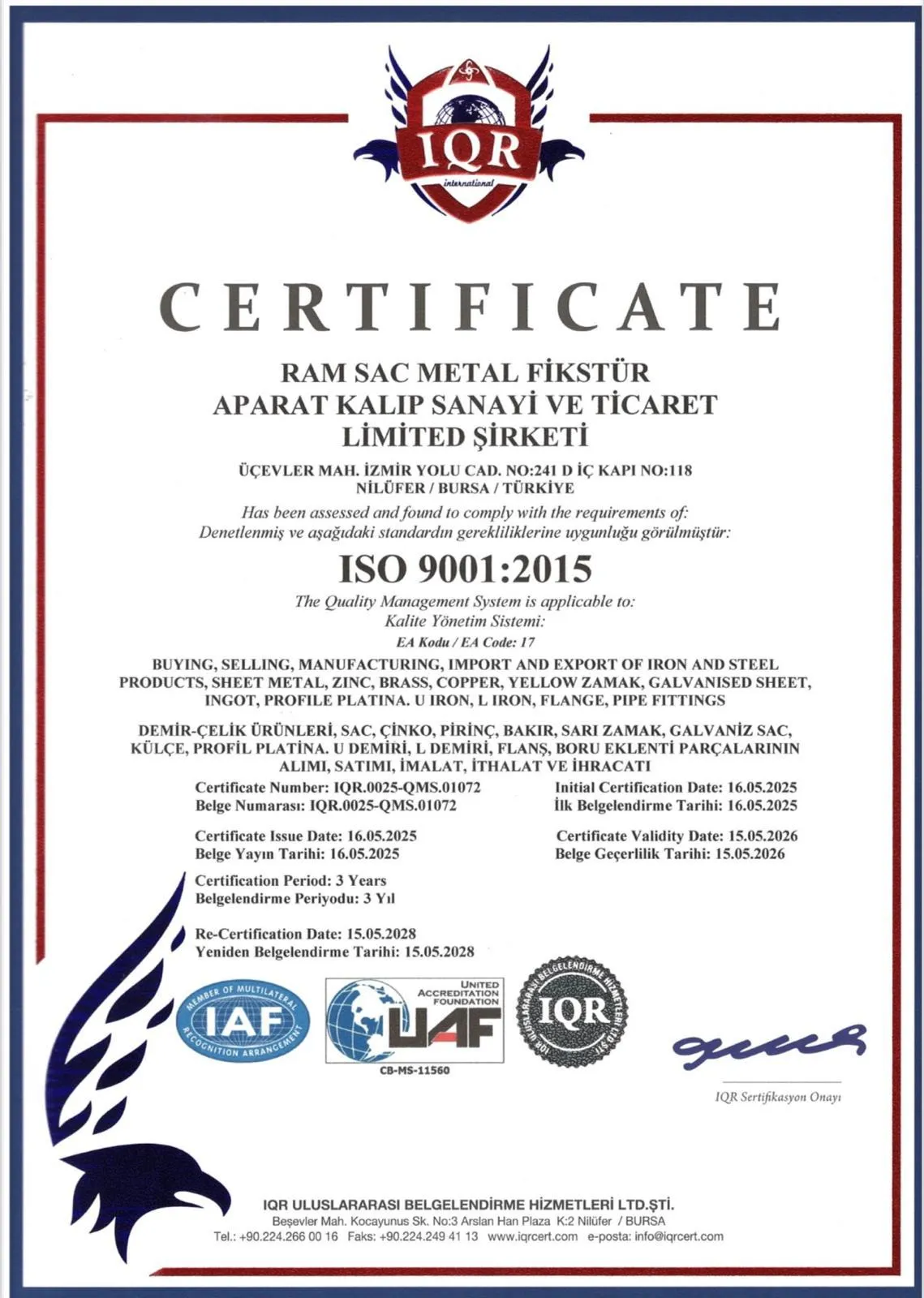
| ISO 9001 certificate | Quality-management system for named entity, site and relevant scope | Entity, site, scope, status and certification body |
| ISO/IEC 17025 accreditation | Competence for specified laboratory tests and calibrations | Required method is listed in the scope |
| Product standard | Grade, condition, mechanical properties, surface and technical requirements | State standard, grade and edition in the order |
| Tolerance standard | Thickness, width, length, flatness and shape | Select normal or narrowed tolerances explicitly |
| MTC / inspection document | Coil or batch identity and ordered results | Match heat, coil, grade, dimensions and results |
| Processing record | Parent coil to slit coil, sheet pack or blank batch | Verify conversion and label-transfer records |
Terms
What buyers usually mean by cold rolling accreditation
ISO 9001 addresses an organization's quality-management system. Its scope should be relevant to cold rolling, annealing, finishing, slitting, steel processing or the activity being purchased; a certificate for an unrelated site or activity is weak evidence.
ISO/IEC 17025 addresses testing and calibration laboratory competence. Accreditation is method- and scope-specific: a laboratory may be accredited for tensile testing but not for every surface, coating, metallographic or chemical-analysis method.
Product compliance remains order-specific. Sector approvals may be relevant only when the buyer's application or contract names them.
Specification
Core standards for cold-rolled sheet and coil
| Standard | Main role in the RFQ | Examples |
|---|---|---|
| EN 10130 | Cold-rolled uncoated low-carbon flat products for cold forming | DC01, DC03, DC04, DC05, DC06 |
| EN 10131 | Dimensional and shape tolerances for cold-rolled flat products | Thickness, width, length, flatness and shape |
| EN 10268 | Cold-rolled high-yield-strength flat products for cold forming | HC220Y, HC260Y, HC260LA-HC500LA |
| ASTM A1008/A1008M | Cold-rolled carbon, structural, HSLA and related sheet | CS, DS, DDS, EDDS and high-strength families |
| ASTM A568/A568M | General requirements for steel sheet | Ordering, dimensions and testing |
| ASTM A370 | Mechanical testing of steel products | Tensile and related test procedures |
| JIS G 3141 | Cold-reduced carbon steel sheet and strip | SPCC and drawing-quality families |
| EN 10204 | Inspection documents for metallic products | Types 2.2, 3.1 and 3.2 |
Production context
Process controls that affect cold-rolled quality
Yield or proof strength, tensile strength, elongation, r-value, n-value, forming-limit data, surface roughness, thickness and flatness each answer different forming or fit-up questions. Request only the evidence your specification needs.
| Process stage | Buyer-relevant outcome | Evidence or RFQ field |
|---|---|---|
| Pickling and incoming hot-band control | Surface cleanliness and feedstock consistency | Feedstock route and surface expectations |
| Cold reduction | Thickness reduction, work hardening and rolling-direction effects | Reduction or delivery route where important |
| Annealing | Recrystallization, formability and property restoration | Batch or continuous annealing; grade and condition |
| Temper / skin-pass | Shape, texture and yield-point behaviour | Skin-pass, elongation, roughness and flatness |
| Surface and oiling | Corrosion protection and visual appearance | Oiled/dry, oil type, amount, surface class and inspected side |
| Slitting / cut-to-length | Width, burr, camber, sheet flatness and identity | Tolerance limits and parent-coil traceability |
Technical evidence
Match the certificate package to the cold-rolled grade decision
The required evidence should follow the actual risk: forming, surface appearance, dimensional fit-up, welding or downstream coating. Do not request an accreditation logo as a substitute for method-specific results.
| Buyer requirement | Relevant evidence | Why the certificate title alone is insufficient |
|---|---|---|
| General forming | DC01 or agreed equivalent, thickness, yield/proof strength and elongation | A quality-system certificate does not establish the ordered coil properties |
| Deep drawing | DC04-DC06 family, r-value, n-value, elongation, ageing condition and lot data | Grade designation alone does not validate the tooling and forming window |
| Higher-strength forming | EN 10268 grade, strength range, elongation, bend/edge and fatigue requirements | Higher yield strength can reduce the available forming margin |
| Visible or painted surface | Surface class, inspected side, roughness, oil and defect limits | Surface quality and roughness are separate from mechanical grade |
| Precision slit coil | Width tolerance, burr, camber, coil build and parent-coil identity | The base MTC may not report downstream processing results |
Verification
How to verify a cold-rolling certificate package
Check the organization and site; confirm the laboratory scope lists the required method; compare product standard, grade and delivery condition with the order; match heat and coil identifiers on the MTC; verify downstream processing records; and document any exceptions before acceptance.
For a cold-rolled coil RFQ, include grade and standard, dimensions and tolerances, surface and oiling, coil ID and weight, annealing or skin-pass requirements where relevant, EN 10204 document type, required test method or accreditation, processing route, packing, destination and Incoterm.
FAQ
Cold rolling accreditation questions
Is ISO 9001 a cold-rolled steel product certificate?
No. It is evidence about a quality-management system. The ordered product standard and coil-specific inspection document establish product evidence.
Should every cold-rolling laboratory be ISO/IEC 17025 accredited?
Only when the contract or applicable requirement calls for accredited testing. Verify that the scope covers the specified method.
Which certificate should come with cold-rolled coil?
State the required inspection-document type in the order, commonly an EN 10204 type where applicable, and match it to heat and coil identity.
Does DC04 automatically guarantee deep-drawing performance?
No. Grade designation alone does not replace the agreed standard edition, delivery condition, dimensions, test requirements and forming review.